

Views: 0 Author: Site Editor Publish Time: 2026-10-13 Origin: Site


Choosing between a carbon fiber cylinder and an aluminum cylinder requires more than comparing empty weight. Buyers must consider working pressure, gas capacity, material construction, inspection requirements, operating environment, and total cost.
Carbon fiber cylinders are composite pressure vessels that use a liner and a carbon fiber overwrap. Aluminum cylinders use a metal body to contain pressurized gas. Each design offers different benefits, and the right choice depends on the cylinder's specifications and intended application.
This guide compares carbon fiber composite and aluminum cylinders to help equipment buyers make informed decisions.
Table of Contents
Comparison Factor | Carbon Fiber Composite Cylinder | Aluminum Cylinder |
|---|---|---|
Construction | Liner with a carbon fiber composite overwrap | Metal pressure vessel |
Weight | Can offer significant weight savings, depending on the model | Often lighter than some steel cylinders, but heavier than certain composite designs |
Working Pressure | Depends on the approved model | Depends on the approved model |
Gas Capacity | Depends on water capacity, pressure, gas, and operating conditions | Depends on water capacity, pressure, gas, and operating conditions |
Corrosion Considerations | Depends on liner, fittings, composite condition, and environment | Aluminum resists red rust but can still suffer from corrosion and surface damage |
Damage Risks | Impact, cuts, abrasion, and damage to the composite overwrap | Dents, gouges, corrosion, thread damage, and other defects |
Inspection | Must follow model-specific requirements | Must follow model-specific requirements |
Service Life | Depends on design, approval, markings, and applicable rules | Depends on design, approval, markings, and applicable rules |
Selection Priorities | Weight reduction and portability where approved | Metal construction, application compatibility, and lifecycle requirements |
This comparison describes general characteristics. Actual performance must be verified using the specifications and approval documents for the exact cylinder.
Aluminum cylinders are manufactured from suitable aluminum alloys using processes defined for the specific design. Depending on the product, manufacturing may include forming, heat treatment, machining, and inspection.
The metal body contains the pressurized gas. Its wall thickness, alloy, heat treatment, dimensions, and manufacturing quality affect the cylinder's strength and approved working pressure.
Aluminum is relatively lightweight compared with many steel designs and does not develop red rust in the same way as carbon steel. However, it is not immune to corrosion, pitting, dents, gouges, or thread damage. The cylinder must be inspected and maintained according to its requirements.
Aluminum cylinders are used in applications such as industrial gas storage, medical gas supply, beverage gas systems, and selected diving applications. Suitability depends on the exact model, gas compatibility, pressure rating, and relevant approval.
See Ruiying's aluminum cylinder product range for model-specific materials, capacities, and ratings.
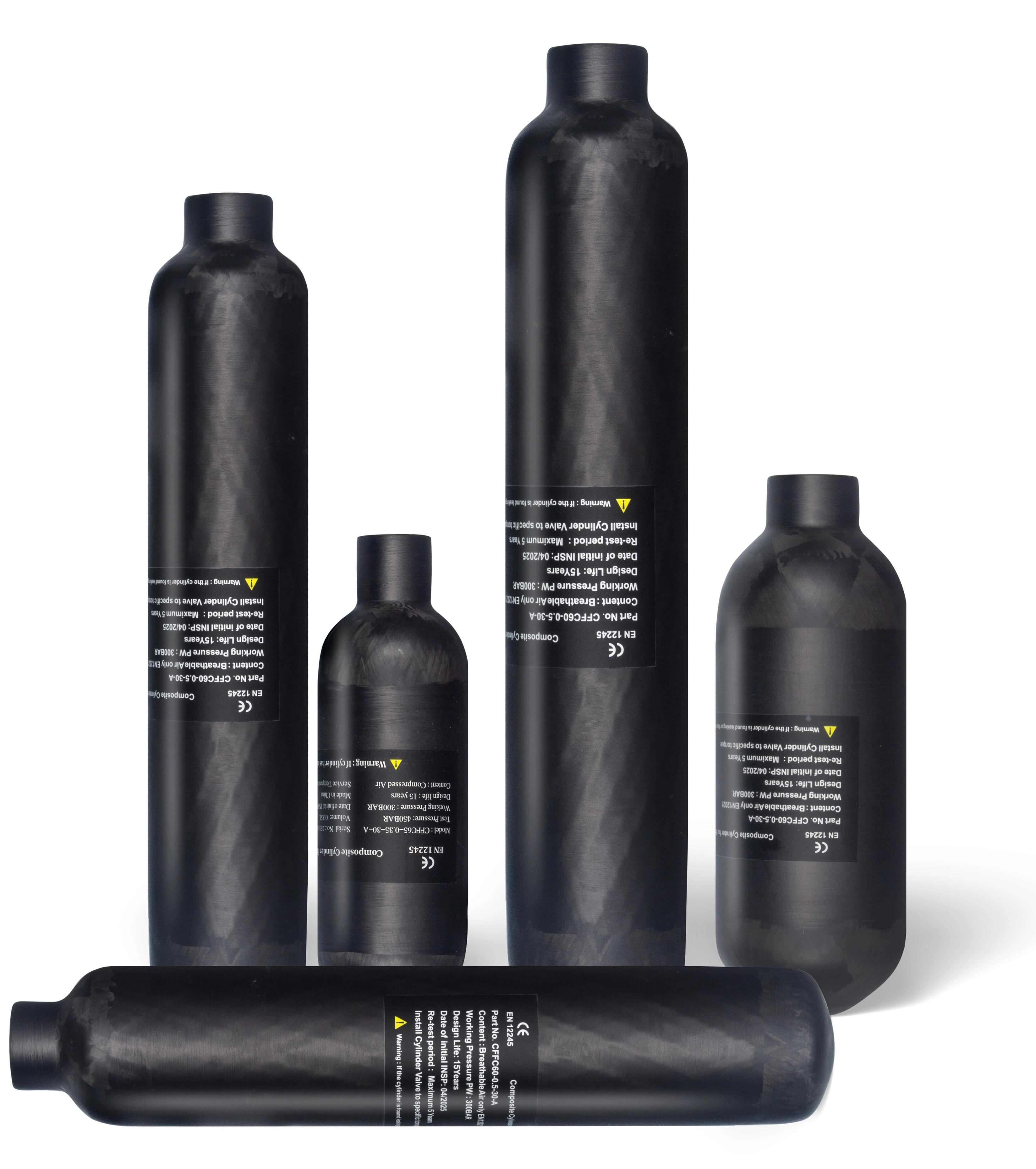
A carbon fiber cylinder is not usually made from solid carbon fiber. It is a composite pressure vessel that combines an inner liner with a carbon fiber overwrap.
Type III cylinders generally use a metal liner, commonly aluminum, while Type IV designs generally use a non-metallic liner, commonly polymer. The liner provides a gas barrier, while the composite overwrap carries a major share of the structural load.
During manufacturing, continuous carbon fibers are wound around the liner in controlled patterns and combined with a resin matrix. The fiber orientation and winding design help the vessel resist stresses created by internal pressure.
The complete cylinder design, including the liner, fibers, resin, end structure, valve, and protective features, determines its performance. A carbon fiber overwrap does not make the cylinder immune to impact or damage.

Ruiying's outdoor sports cylinder range lists Type III carbon fiber cylinders with model-specific working pressure, test pressure, capacity, dimensions, and weight.
Weight is one of the main reasons buyers consider carbon fiber composite cylinders. A composite design can reduce cylinder weight compared with some metal-cylinder designs of comparable capacity and pressure rating.
Lower weight can make equipment easier to carry and transport. This may be useful for portable pneumatic devices, selected breathing-air systems, and other applications where the cylinder forms part of a mobile assembly.
Aluminum cylinders are also used where weight matters. They are generally lighter than many steel cylinders, although a suitable composite cylinder may offer further weight savings.
Do not compare empty weights alone. A fair comparison should consider:
The same or suitable gas capacity
The required working pressure
The complete cylinder and valve assembly
Protective accessories and mounting hardware
Applicable approval and operating requirements
The actual weight difference varies by model. Buyers should use product specifications rather than a universal percentage.
A cylinder's working pressure is a model-specific rating. Carbon fiber construction does not automatically mean a cylinder is rated for 4,500 PSI, and aluminum cylinders are not limited to one universal pressure.
For example, Ruiying lists selected Type III outdoor sports cylinders with a 30 MPa working pressure and a 45 MPa test pressure. These figures apply to the listed models and should not be generalized to all carbon fiber cylinders.
Aluminum cylinders are also available in different pressure ratings. Buyers must check the approved working pressure marked on the cylinder and the manufacturer's documentation.
When comparing pressure and capacity, confirm:
Rated working pressure
Test pressure, where applicable
Water capacity and required gas supply
Gas compatibility and valve connection
Filling equipment and connection compatibility
Certification and destination-market requirements
Higher pressure may allow more gas to be stored in a given water capacity under suitable conditions. However, usable gas supply also depends on the gas, temperature, filling conditions, and operating requirements.
Never fill a cylinder beyond its approved rating or use a filling system that is not suitable for the cylinder.
Carbon fiber composite and aluminum cylinders face different risks. Neither material should be treated as damage-proof.
Aluminum does not develop red rust like carbon steel, but it can still experience corrosion and pitting. Moisture, contaminants, unsuitable cleaning chemicals, and contact with other materials may affect the cylinder or its fittings.
Dents, deep gouges, damaged threads, or signs of corrosion require assessment according to the applicable inspection rules. A cylinder's appearance alone cannot establish that it is safe to continue using.
Composite cylinders can be vulnerable to impact, cuts, abrasion, and damage to the overwrap. Some damage may not be easy to assess without a qualified inspection.
Exposure to heat, ultraviolet radiation, chemicals, or unsuitable storage conditions may also affect certain materials or protective layers. Follow the manufacturer's limits for temperature, handling, storage, and cleaning.
If either type of cylinder is dropped, involved in an impact, or shows suspicious damage, remove it from service and seek a qualified assessment. Do not attempt to repair a pressure vessel yourself.
The service life and inspection schedule of a gas cylinder depend on its design, approval, markings, intended use, and applicable regulations. There is no single service-life limit or testing interval that applies to every aluminum or carbon fiber cylinder worldwide.
Some composite cylinders are subject to defined service-life limits under their applicable approvals. Other requirements depend on the specific product and market. Do not assume that every carbon fiber cylinder expires after 15 years or that a service life can be extended by passing a test.
Aluminum cylinders also require scheduled inspection and testing. Passing an inspection does not automatically authorize indefinite service.
Before purchasing a cylinder, confirm:
The manufacturing date and applicable service-life limit
The required visual inspection and retesting intervals
Any model-specific inspection procedures
The records and markings required for the destination market
The conditions that require removal from service
Inspection methods may vary by cylinder type, alloy, design, and approval. For example, some aluminum cylinders may have additional inspection requirements related to their alloy or neck threads. Follow the applicable instructions rather than applying one procedure to every cylinder.
The best cylinder depends on the application, not just the material.
Weight and pressure may both matter for portable pneumatic equipment. Carbon fiber composite cylinders can be useful when a compatible, approved model provides the required pressure and capacity with less weight.
Before selection, verify the cylinder's working pressure, valve connection, filling method, and compatibility with the equipment.
In breathing-air applications, a lower cylinder weight may help with mobility. However, the complete cylinder assembly must be approved for the intended breathing-air use and must meet all applicable performance and inspection requirements.
Do not choose a cylinder solely because it is lightweight or has a high pressure rating.
For underwater use, buoyancy is an important factor. A cylinder's buoyancy changes with its material, dimensions, wall construction, and gas content. The diver's full equipment configuration also affects overall buoyancy and trim.
Aluminum cylinders are used in approved scuba applications, but their suitability depends on the model. A composite cylinder should only be used underwater if the specific product is approved for that use and its handling, buoyancy, and maintenance requirements are understood.
Do not assume that all carbon fiber cylinders are suitable for scuba diving or that all composite cylinders have the same buoyancy characteristics.
Both aluminum and composite cylinders may be suitable for selected gas-supply applications. Buyers must confirm gas compatibility, required capacity, working pressure, valve type, certification, and applicable cleanliness or service requirements.
Ruiying offers different gas cylinder products for industrial, medical, and other applications. The correct selection depends on the exact gas and intended use.

Maintenance requirements differ by cylinder design. Follow the cylinder's inspection schedule, cleaning instructions, storage conditions, and service-life restrictions.
Filling equipment must be compatible with the cylinder's approved working pressure and valve connection. A high-pressure cylinder may not be suitable for a filling station that cannot safely provide the required pressure or connection.
Before procurement, check:
Maximum output pressure of the filling equipment
Valve and connection compatibility
Required gas quality and filtration
Inspection and maintenance support
Availability of approved replacement components
Local service and testing options
Do not modify valves or adapters to force an incompatible connection. Confirm compatibility with the manufacturer or a qualified filling provider.
Use the following steps to narrow down the options.
Identify the gas, equipment, operating environment, and whether the cylinder will be carried, mounted, transported, or used underwater.
Specify the required working pressure and gas capacity. Compare complete product specifications rather than general claims about material performance.
Consider how often the cylinder will be moved, the weight of the complete assembly, and any mounting or transport requirements.
Check the cylinder markings, applicable approval, required inspection procedures, and service-life limits before purchasing.
Verify that the exact cylinder is approved for the intended use and destination market. Confirm filling compatibility, documentation, maintenance support, and replacement availability.
For customized requirements, Ruiying's OEM high-pressure cylinder service provides a starting point for discussing capacity, working pressure, dimensions, valve configuration, and other project specifications.
Carbon fiber composite and aluminum cylinders offer different benefits. Carbon fiber composite designs can provide weight savings in applications where the specific model is approved for use. Aluminum cylinders offer metal construction and are available for many industrial, medical, beverage, and diving applications.
The right choice depends on the exact working pressure, gas capacity, weight, operating environment, certification, inspection requirements, and total cost. Avoid relying on general statements about universal pressure ratings, service lives, or suitability for underwater use.
Before ordering, confirm the product specifications and regulatory requirements with the manufacturer or qualified supplier.
A carbon fiber composite cylinder can be lighter than a comparable aluminum cylinder, but the difference depends on capacity, pressure rating, design, valve, and accessories. Compare the specifications of the exact models.
Some carbon fiber cylinders are designed for higher working pressures than some aluminum cylinders. However, the permitted pressure depends on the individual model and its approval, not the material alone.
Yes, service-life and inspection requirements may differ. They depend on the cylinder design, markings, approval, intended use, and applicable regulations. Check the requirements for the exact cylinder.
Only if the specific cylinder is approved for underwater use. Buyers and divers must confirm its certification, buoyancy characteristics, gas compatibility, and maintenance requirements.
Confirm the gas type, working pressure, capacity, valve connection, weight, intended application, applicable certification, inspection requirements, service-life limit, and filling equipment compatibility.

